CJ as primus inter pares: The nature of leadership in the judicial department
A “first among equals”, a person who has a precedence and executive authority within an institution, while maintaining equal value of vote along with the other members of the court relevant to judicial decision-making.
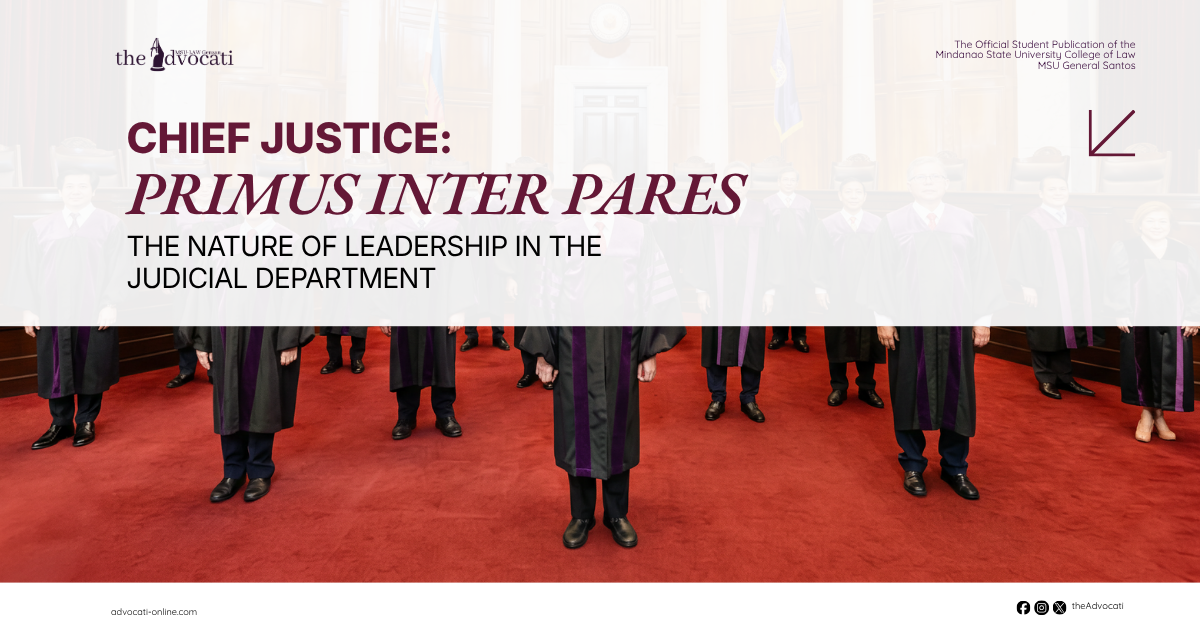
On November 5, 2026, President Ferdinand “Bongbong” Marcos appointed Associate Justice Rodil Zalameda as the 28th Chief Justice of the Philippines. The same day of the retirement of Chief Justice Alexander G. Gesmundo, after reaching the mandatory retirement age of seventy. Due to this remarkable change of leadership in the Supreme Court, it is imperative to understand the role of a Chief Justice as he leads with unique moral suasion to the court and other governmental bodies.
Former Chief Justice Renato Corona, hours before his impeachment trial in December 2011, expressly invoked the principle of “primus inter pares” asserting that a Chief Justice has a fundamental duty to defend the institution when threatened and is bound to be at the forefront of the fight for democracy. Moreover, he pointed out that it should be the same for the senators who are likewise duty-bound to be at the forefront of defending democracy, justice and equality above political loyalty.
But what does Primus Inter Pares actually mean? At its core, it came from a Latin phrase which can be literally translated to “first among equals”. This pertains to a person who has a superior administrative rank, ceremonial precedence and executive authority within an institution, while maintaining equal value of vote along with the other members of the court relevant to judicial decision-making.
This principle illustrates the delicate balance of the Chief Justices’ administrative leadership in the Philippine Judiciary and their equal standing among other associate justices. While the 1987 Constitution of Philippines vested him the highest judicial position, his vote counts exactly as one vote and does not outvote or override the majority or single-handedly maneuver the direction of Philippine Jurisprudence. Therefore, Chief Justices bear no higher judicial rank or weighted vote than any associate justices relevant to deciding cases.
To analyze systematically, the office of the Chief Justice is divided into two distinct pillars. The Parity in Adjudication as Inter Pares and his Primacy in Administration and Protocol as Primus.
Parity. Basically, this means equality in power and decision making. On the bench, there are a few attributes of his position including his lack of capacity to influence how other justices vote to ensure equal dignity of the fifteen magistrates. Moreover, the court en banc acts as a collegiate court which means that he cannot overturn any decision because the case was a product of collective deliberation and must follow the majority vote of those who have participated or are present at the time. Therefore, he does not possess any tie-breaking superiority.
To clarify ambiguity, it is also necessary we understand the Chief Justices’ role as the ponencia of Supreme Court en banc decisions. Ponencia is often mistaken as the power possessed by Chief Justices to decide over a case. This is wrong, ponencia came from the Spanish word of ponente which translates to “the one who presents the case” meaning it is his assignment to write the complete opinion of the court containing the facts, the issue, reasoning and the final ruling of the case. It does not mean he alone decided the case, or he has the capacity to change ruling in writing. As a matter of fact, collegiality is the principle that judicial power is vested in the body of the court as whole and not on the individual. The purpose is to ensure equal dignity to the fourteen associate justices.
Primacy. The constitution vests in him the authority to become the administrative head over all courts. Off the bench, the Chief Justice is duty-bound to be first in leadership. Hence, his role is basically the chief executive officer of the institution who not only acts as the presiding officer of Supreme Court en banc sessions, but also the supervisor of all judicial functions and as administrator of the entire judiciary. He is likewise the representative of the judicial department, standing at the forefront when defending the institution to protect its independence, especially when there is a crisis threatening the constitutionally vested authority of the judiciary.
Finally, why must primacy and parity coexist? Because the primacy will give the court its leader but the parity will give them legitimacy. They must coexist to ensure that the other half of the institution possess the ability to have direction and accountability, and not as a headless, one-man department. For a Chief Justice position is not vested just to impose superiority among others but also a position of responsibility.